Sarajevo is one of those cities that surprises people who think they already know what to expect. These are the five places that define it — chosen not from a guidebook, but from over a decade of walking these streets with guests from all over the world.
Sarajevo rewards the curious. It is a city where four centuries of history exist within a single walkable neighbourhood, where a waterfall once sat inside a market, and where the scars of a recent siege sit quietly alongside some of the most vivid daily life in Europe. If you only have a few days, these five stops will give you the sharpest possible picture of what this city actually is.
1. Latin Bridge
Start here. On the surface it is a modest Ottoman bridge crossing the Miljacka river — and then your guide tells you what happened on this exact spot on 28 June 1914. The assassination of Archduke Franz Ferdinand, the event that triggered World War I, happened at the northern end of this bridge. Standing there and understanding that a single moment in this small city reshaped the entire 20th century is one of the most quietly remarkable feelings in European travel.
2. Baščaršija — The Old Bazaar
Sarajevo's old bazaar has been functioning continuously since the 15th century. Coppersmith Street still rings with the sound of hammers on metal. The Sebilj fountain at its centre has been a meeting point for generations. The coffee served here — Bosnian coffee, slow and unfiltered, in a small copper džezva — is not a tourist product. It is simply how people here have started their mornings for 500 years. Sit down. Take your time. The bazaar has nowhere to be.
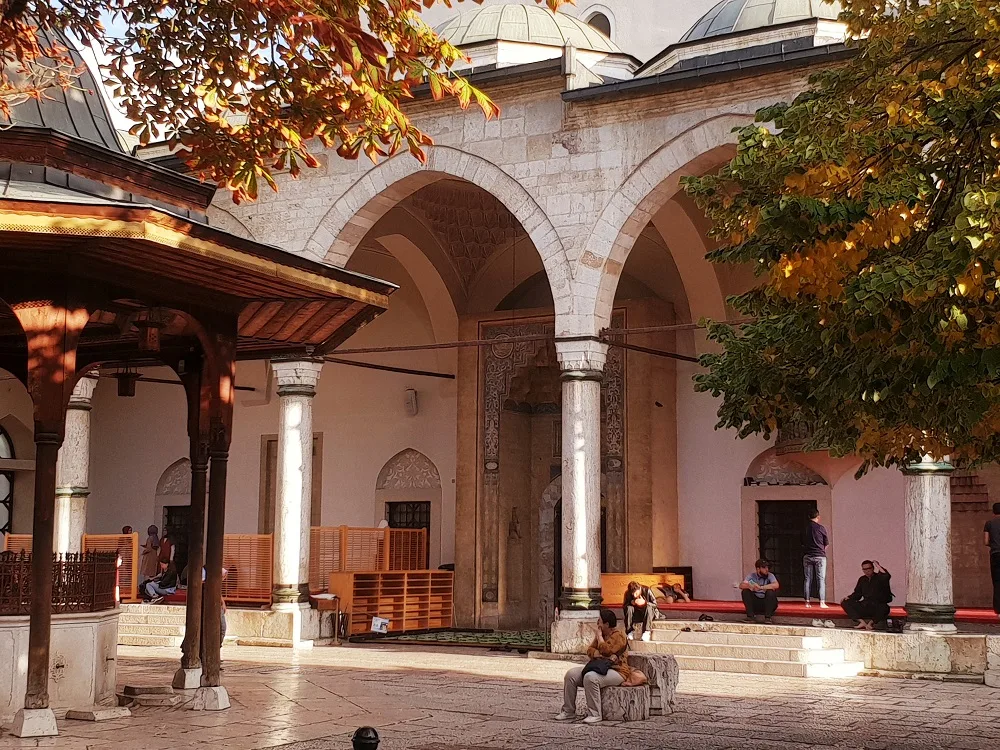
3. Gazi Husrev-Bey Mosque
Built in 1531, this is the finest Ottoman mosque in the Balkans and one of the most beautiful buildings in the region by any measure. Its courtyard fountain, its proportions, its atmosphere of continued daily use — nothing about it feels like a museum piece. It sits at the heart of the old town surrounded by a library, a covered market, and a madrasa, all built in the same era, all still serving their original purpose. That continuity is rare anywhere in the world.
4. The East-West Line
There is a precise point in Sarajevo where the Ottoman old town ends and the Austro-Hungarian city begins. The architecture changes within a single step — from low Ottoman rooflines and minarets to wide Viennese boulevards and Catholic spires. No other city in Europe has this. Walking that line with someone who can explain how it got there — through centuries of empire, war, and negotiation — is one of the most genuinely educational moments available on any city walk anywhere on the continent.
5. City Hall — Vijećnica
Sarajevo's City Hall is one of the most striking pieces of architecture in the western Balkans — a grand neo-Moorish building completed in 1896 during the Austro-Hungarian period. On 25 August 1992, it was deliberately shelled and burned, destroying over two million books and irreplaceable manuscripts. It was rebuilt over two decades and reopened in 2014. Standing inside it now, knowing what it survived and what it represents, completes a picture of Sarajevo that no single landmark can give you alone: a city that has been destroyed before, and has always rebuilt.
Sarajevo does not ask you to fall in love with it. It simply shows you what it is. That tends to be enough.